Butcher Hero: Monster Idle RPG
- 4.1
- Rating
- 1.00M
- Installs
- Free
- Price

 Analysis by App-foxy
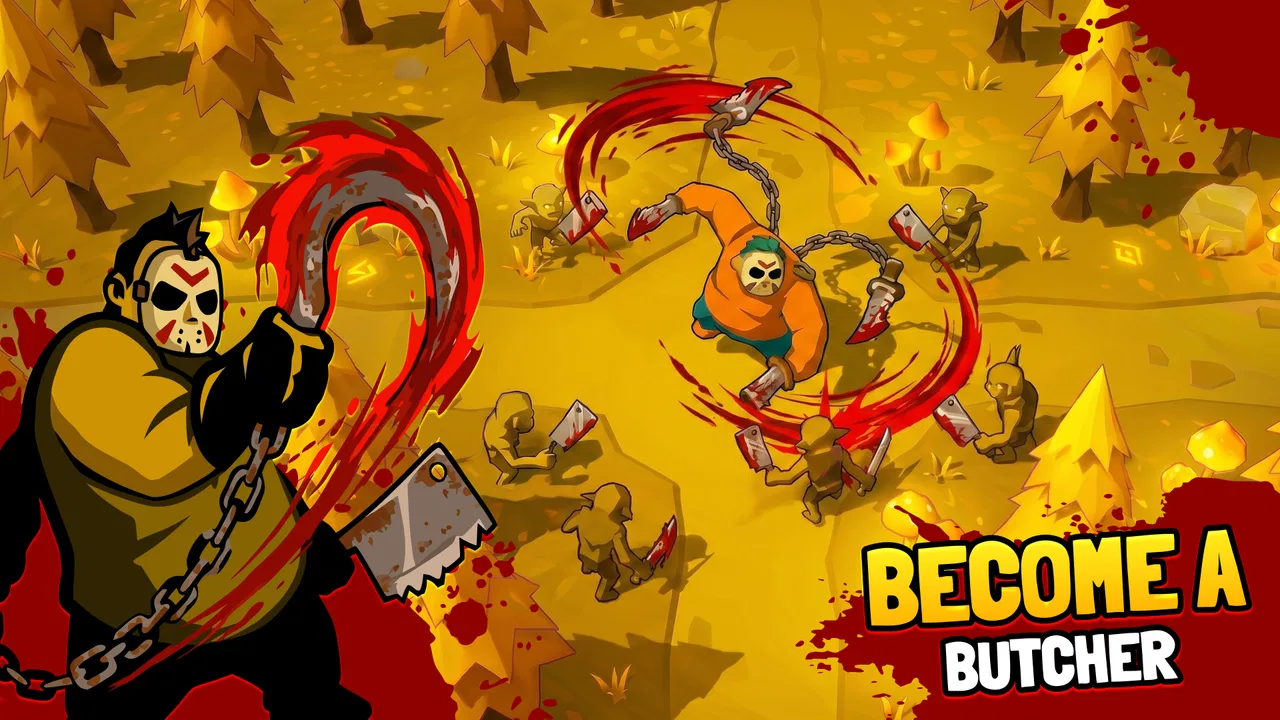
Butcher Hero: Hook'n'Chew RPG is the kind of mobile role-playing game that makes a strong first impression through a simple promise: enter a hostile world, fight monsters and aliens, improve your equipment, and push toward tougher bosses. I found its appeal easy to understand. It is built for short bursts of action, but it also gives you a reason to return because every upgrade changes how prepared you feel for the next dangerous encounter.
What makes it worth discussing is not just the survival theme. The more important question is whether the progression feels satisfying without turning every obstacle into a request to spend money. The game is free to download, and its in-app purchases range from $1.99 to $99.99 per item. That broad range makes the spending question impossible to ignore, especially for players who enjoy role-playing games but dislike pressure around upgrades.
After spending time with it, I see a focused experience rather than a huge role-playing adventure. It is best approached as a compact combat-and-progression game: enter a fight, manage your equipment and improvement choices, deal with increasingly threatening enemies, and decide how far you want to push before the next boss. If you like that loop, the game has a clear identity. If you want a deep story, a large social world, or a carefully balanced competitive scene, you may want something more substantial.
You May Also Like

 Blood Strike: 2.5 Anniversary
Blood Strike’s Loadouts Turn Every Drop Into a Tactical Gamble
A close look at Blood Strike’s custom loadouts: how fast access to signature weapons reshapes its battle royale rhythm, rewards preparation, and narrows the gap between fights.

 Pandora - Music & Podcasts
Pandora’s Music Is Easy to Start, but Harder to Recover
Pandora’s strength is its low-effort path from a seed to a station. Its weak spot is how much confidence it asks you to place in connection, setup, and quiet recovery.

 8 Ball Pool
 Is Built on Rivalries, Rematches, and Routine
A close look at the rivalries, rematches, shared routines, and unanswered safety questions that turn a quick pool match into a persistent mobile community.

 Samsung Music
’s Quiet Strength Is Playing What You Already Own
Its reach comes less from spectacle than from dependable access to a personal library. That simplicity is both the app’s strongest retention engine and its ceiling.

 AccuWeather: Weather Radar
AccuWeather Review: A Quick, Clear Forecast for Everyday Decisions
For everyday plans, the best forecast is the one you can understand quickly. AccuWeather makes rain timing, radar, and local conditions easy to act on, with a few trade-offs.

 Hill Climb Racing
Why Hill Climb Racing Still Turns Crashes Into One More Run
A tiny car, a bumpy hill and one more upgrade: Hill Climb Racing keeps resurfacing because its simple chaos makes every near-miss feel personal.
More From Our News Desk



How the survival RPG loop feels in practice
I look at this section through the rhythm of an ordinary attempt: how quickly the game gives me a clear combat goal, and whether a short visit feels complete rather than rushed. That distinction matters when I’m choosing something to play in a spare moment, because a survival RPG should make progress understandable without demanding a long session. The next section turns to what happens when I push that loop harder.
Combat gives every session a clear purpose
The strongest part of the concept is its directness. You are not wandering through a role-playing game with a long list of unrelated chores. The central activity is survival through combat. Monsters and aliens provide the immediate threat, while gear upgrades give each successful run a practical reward. That structure makes it easy to understand what I should do next: fight, improve, and test the result against a stronger challenge.
I particularly like this format for mobile play because it does not require a large block of free time to make progress feel meaningful. A quick session can still have a clear beginning and end. I can enter with a specific goal, such as improving my equipment or seeing whether my current setup can handle a boss, rather than opening the game without knowing what deserves attention.
That simplicity also creates the main danger. A survival RPG can become repetitive when the combat encounters stop asking new questions. The game needs its enemies, gear choices, and boss battles to keep changing the way I approach each attempt. When an upgrade feels like a genuine answer to a problem, progression is rewarding. When it only increases numbers without changing my decisions, the loop becomes more routine.
Gear decisions matter more than rushing forward
My practical advice is to treat every equipment improvement as preparation rather than decoration. It is tempting to spend resources immediately whenever a new upgrade appears, but a better habit is to ask what currently stops you. If ordinary enemies are manageable but bosses overwhelm you, saving for a stronger improvement may be more useful than making several small changes that do not solve the real weakness.
This is one of the less obvious ways to get more from the game. Instead of judging progress by how quickly I can move into the next area or encounter, I judge it by whether my character can survive the specific threat that previously ended a run. That approach reduces waste and makes the upgrade system feel more deliberate, even when the available choices are limited.
Players should also expect a game that rewards patience. A survival-focused RPG is rarely at its best when played as a constant sprint. Repeating a manageable encounter to strengthen equipment can feel slower than charging into a difficult fight, but it usually gives a clearer picture of whether I am actually ready. This matters especially for anyone who wants to avoid spending simply because a boss feels just out of reach.
Bosses are the real test of your preparation
Regular enemies help establish the rhythm, but bosses are where the progression loop proves its value. They create a useful checkpoint: either my current gear and decisions are enough, or I need to rethink how I am preparing. I prefer this kind of pressure to a system where every fight feels identical, because a boss gives the session a concrete objective.
The trade-off is that boss-based progression can feel abrupt. A player may move comfortably through routine encounters and then meet a sudden wall. When that happens, the best response is not always to keep repeating the same attempt. I would first review whether I have been upgrading efficiently, then decide whether a slower preparation cycle is sensible. If the game offers a purchase that appears to shorten that process, I would treat it as optional convenience rather than an automatic requirement.
That distinction is important. I do not want to claim that purchases are necessary or that the game is unfair, because the available purchase information only establishes that optional items exist and that their prices cover a wide range. My experience-based recommendation is simply to play long enough to understand the normal progression before deciding whether any purchase improves your enjoyment.
What a normal everyday session looks like
Imagine having a short break between errands or before dinner. This is where the game makes the most sense to me. I can open it with one small aim: clear a few encounters, collect enough progress for an equipment improvement, or make one attempt against a boss. The survival theme gives that short session more direction than a game that relies purely on endless tapping or unstructured collection.
For a longer evening session, the experience depends on how comfortable you are with repetition. If you enjoy gradually turning a weak character into a reliable fighter, the repeated battles can be relaxing. If you need constant story scenes, new locations, or dramatic mechanical changes, the same structure may begin to feel narrow. I would not choose this as my main role-playing game if I wanted a large narrative commitment.
Spending, progression pressure, and fairness
Here I focus on the point where a quick run becomes a longer stretch of play: repeated fights, gear decisions, and the temptation to treat a purchase as a shortcut after a setback. I find it more useful to judge those moments by whether they still leave me with meaningful choices, rather than assuming that a long session is automatically a better one. That leads into a closer look at reliability.
The purchase range deserves attention
Butcher Hero: Hook'n'Chew RPG is free to play, which lowers the barrier to trying it. The listed in-app purchases run from $1.99 to $99.99 per item, so the game includes both small and very expensive purchase points. That does not, by itself, prove that the game is aggressive or unfair. It does mean that I would approach spending carefully and decide on a personal limit before buying anything.
The sensible way to evaluate the economy is to play without paying during the opening sessions and observe how progress feels. Can I improve equipment through normal play? Do difficult encounters encourage better decisions, or do they mainly make me wait? Does a purchase solve a genuine inconvenience, or does it become attractive only after repeated frustration? Those questions are more useful than assuming either that every free RPG is generous or that every paid item ruins the experience.
I would also avoid making a purchase immediately after losing to a boss. That is the moment when the game is most likely to make extra progress feel emotionally urgent. Waiting until the next day is a simple but effective test: if I still want the item because it adds convenience, that is a considered choice; if the desire disappears, it was probably frustration talking.
Why free access does not automatically mean low pressure
Free entry is valuable, but it changes the way progression needs to be judged. A game can be enjoyable without payment and still make certain moments feel uncomfortable if the path forward slows sharply. In this title, the combination of survival battles, equipment improvement, and boss encounters naturally creates opportunities for that pressure. Every difficult fight can make a shortcut feel tempting.
My recommendation is to separate three kinds of progress. First, there is progress that comes from learning how to handle the combat. Second, there is progress from improving gear through ordinary play. Third, there is progress that may be accelerated by spending. The game is most satisfying when the first two remain meaningful. If a player feels that only the third option matters, the experience becomes much less appealing, even if the purchases are technically optional.
For parents, the Everyone 10+ rating is a useful starting point, but it should not replace supervision around purchases. The game is free to install, while individual in-app items can be costly at the upper end. I would use device-level purchase controls and talk with younger players about whether buying an upgrade is allowed. That is practical advice based on the purchase structure, not a claim about any particular payment prompt.
Can it be enjoyed without spending?
Yes, I would begin with that assumption. The game’s core appeal is available through its free download, and the basic loop is clear enough to test without committing money. A no-spend player should focus on learning which improvements solve actual problems, resist upgrading randomly, and accept that some boss attempts may require more preparation.
The important caveat is that I cannot promise every stage of progression will feel equally comfortable without purchases. The presence of items priced as high as $99.99 means that spending is a meaningful part of the product’s design, even though that does not tell me exactly how often players will see offers or what each item does. My honest verdict is to treat payment as optional convenience and stop playing if progress starts feeling like a negotiation rather than a game.
Is it suitable for competitive players?
This is where I would be cautious. The central experience is framed around survival, gear improvement, monsters, aliens, and bosses. That gives me a strong reason to improve my own performance, but it does not automatically make the game a fair competitive arena. Without a clearly established player-versus-player structure, rankings, or tournament rules to evaluate, I would not choose it primarily for competition.
For players who enjoy comparing builds with friends, the game may still be entertaining as a personal progression challenge. You can discuss which upgrades helped, compare how quickly you reached a boss, or share strategies for surviving difficult encounters. That is different from a competitive system where spending could directly affect another person’s result. I would keep those expectations separate.
If your priority is a tightly balanced contest in which mechanical skill matters more than gear access, a dedicated competitive role-playing game may be a better fit. But if you prefer competing against the game’s enemies and measuring your own improvement, the survival structure is more appropriate.
What remains uncertain and how that affects trust
I weigh trust by separating what the game clearly establishes—its survival-combat premise and progression focus—from expectations players might bring from larger RPGs. That keeps my recommendation grounded: I can assess whether the stated concept suits a player without treating unconfirmed features as promises. The following section considers how that distinction should shape confidence in the experience.
Do not confuse a clear premise with a complete feature promise
The game communicates its main direction well: survival combat, equipment improvement, and boss encounters. That is enough to decide whether the theme interests you. It is not enough to assume the presence of every feature common in larger role-playing games. I would not install it expecting a sprawling story, extensive character dialogue, guild systems, or a deep social layer unless those elements become clear during play.
This is not a criticism of the game’s focus. In fact, a narrow design can be a strength when it avoids unnecessary systems. The useful distinction is between wanting a compact combat loop and wanting a full-scale role-playing world. I see this title much closer to the first category.
Version and device considerations
The current version is 1.3.8, and the game requires Android 6.0 or newer. That makes checking the operating system worthwhile before downloading, particularly on an older phone or tablet. Compatibility is not the same as ideal performance, so I would also leave enough storage and close demanding background apps if the device is modest.
Because this is a combat-focused game, responsiveness matters more than it would in a purely turn-based menu experience. If controls feel delayed or the device becomes warm during longer sessions, shorter play periods may be more comfortable. I would not judge the entire game from one rushed test on an old device, but I would take any repeated performance friction seriously because it directly affects boss fights.
What the audience response suggests
The game has an average rating of 4.1 from around twelve thousand ratings, with 248 written reviews and more than 100,000 installs. Those figures suggest that a meaningful audience has tried it and that the overall response is positive, though not universally enthusiastic. I read that as a reason to investigate the fit rather than as a guarantee that every player will enjoy it.
The ratings also make the game feel established enough to try without treating it as an unknown experiment. At the same time, written reviews are most useful when they match your priorities. A player praising quick combat may have a completely different standard from someone looking for a rich narrative or a generous free-to-play economy. I would pay attention to comments about progression and spending rather than relying on the average alone.
Who should install it, and who should skip it?
I would recommend it to players who enjoy compact survival RPG sessions, visible equipment growth, enemy-focused combat, and the satisfaction of preparing for a boss. It is also a reasonable choice for someone who wants to try a free game before deciding whether the loop deserves more time. The low commitment at the start is one of its practical advantages.
I would skip it if your main requirement is a long story, a large exploration map, or a competitive environment with transparent player-versus-player balance. I would also be careful if you are easily pulled into spending after a difficult loss. The combination of free access and purchases reaching $99.99 per item means self-control matters more here than it does in a fully paid game.
It may also be a poor match for players who dislike repeating encounters to earn better equipment. Survival progression depends on accepting that some battles may need to be revisited. If you want every attempt to reveal something completely new, the game’s focused loop could feel too narrow.
My final trust verdict
My overall impression is favorable but measured. Butcher Hero: Hook'n'Chew RPG has a clear reason to exist: it turns monster-and-alien survival into a straightforward role-playing progression loop built around combat, gear, and bosses. I like that a short session can have a concrete goal, and I think the game will appeal to anyone who enjoys gradually changing an underpowered character into a more dependable fighter.
The main reason I would not give it an unconditional recommendation is the purchase structure. Free access makes trying it easy, but the wide range of in-app prices means players should establish boundaries before the first difficult progression wall. I would play without spending, learn how the normal upgrade path feels, and only consider a purchase if it adds convenience without replacing the satisfaction of earning progress.
Developer MULTICAST GAMES has positioned the game around a compact survival fantasy rather than an all-purpose role-playing world. That focus works in its favor when I want quick, goal-driven action. It works against the game when I am looking for deep narrative or serious competition. The age rating of Everyone 10+ also makes it approachable for a broad audience, provided adults keep an eye on purchase controls for younger players.
My practical verdict is simple: try it as a no-spend survival RPG first, not as a promise of endless content or perfectly competitive balance. If the battles remain enjoyable while you build equipment at your own pace, the game can become a pleasant routine. If every boss turns into a reason to buy progress, or if repetition bothers you quickly, uninstalling is the better choice. For the right player, its focused loop is enough; for everyone else, the free download is best treated as a quick test rather than a long-term commitment.
FAQs for Butcher Hero: Monster Idle RPG
01What is Butcher Hero: Hook'n'Chew RPG about?
Butcher Hero: Hook'n'Chew RPG is an action-packed role-playing game where players take on the role of a heroic butcher using unique skills to battle against various enemies. The game combines strategic gameplay with dynamic combat mechanics, featuring a hooking system that allows players to pull enemies closer for devastating attacks.
02Is Butcher Hero: Hook'n'Chew RPG free to play?
Yes, Butcher Hero: Hook'n'Chew RPG is free to download and play. However, the game includes in-app purchases that allow players to buy additional items, upgrades, and customization options. These purchases are optional and not necessary to progress through the game, but they can enhance the gameplay experience.
03What are the main features of Butcher Hero: Hook'n'Chew RPG?
The game offers a variety of features, including an engaging story mode, a unique hooking mechanic, and a wide range of weapons and abilities to customize your hero. Players can enjoy both solo missions and multiplayer modes, providing a comprehensive RPG experience with plenty of challenges and rewards.
04What devices are compatible with Butcher Hero: Hook'n'Chew RPG?
Butcher Hero: Hook'n'Chew RPG is available on both Android and iOS platforms. To ensure optimal performance, it is recommended to have a device with a recent operating system version and sufficient processing power. Check the app store listing for specific OS requirements and device compatibility before downloading.
05How does the hooking mechanic work in Butcher Hero: Hook'n'Chew RPG?
The hooking mechanic in Butcher Hero: Hook'n'Chew RPG is a core element of gameplay, allowing players to target and pull enemies towards them. This can be used strategically to control the battlefield, chain combos, or isolate enemies for powerful attacks. Mastering this mechanic is key to progressing through challenging levels and achieving higher scores.
Pros
- Engaging combat mechanics with strategic depth.
- Unique hero abilities add tactical variety.
- Colorful graphics enhance the gaming experience.
- Frequent updates with new content and features.
- Offline play mode available for convenience.
Cons
- Some levels may feel repetitive over time.
- In-app purchases can be quite expensive.
- Limited character customization options.
- Occasional lag on older devices.
- Tutorial lacks depth for new players.

Butcher Hero: Monster Idle RPG
Gallery